Saturday, 21 November 2009

Holiday Shopping: Part I & A Give-Away

In the States, we often use the Thanksgiving weekend as the mark for the beginning of the Christmas Shopping season, but in light of the current economy, I am going to begin early and do a lot of local shopping and show you what I’ve found. I am sure that if you see something you MUST have, you can call the shop mentioned and see if you can make arrangements to acquire it.

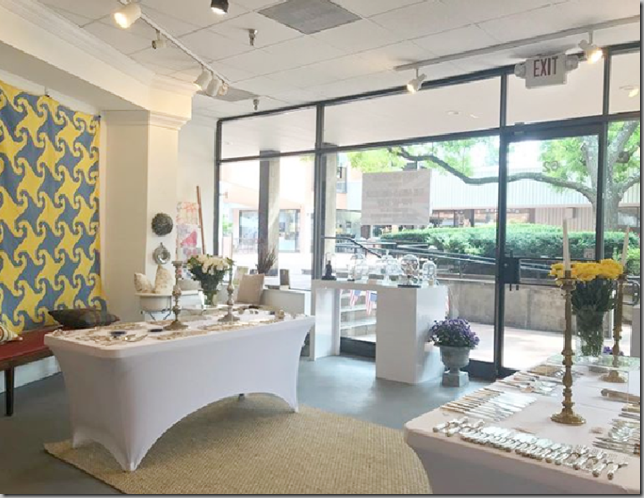
While my friend David at McLain-Wiesand usually makes spectacular custom furniture, he and his crew of elves are busy making goodies for Christmas. And to make it even easier to get some of their small pieces, they’ve opened for business on Saturdays, from now until Christmas from 11 a.m. to 3 p.m. So stop by for a look around, some cookies and perhaps some Christmas cheer.

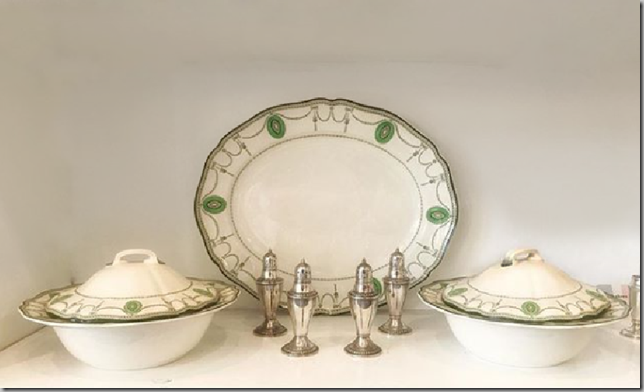
Here is some of what’s on offer at McLain Wiesand:

A pair of classical figural candlesticks $45.00/pairMcLain Wiesand 11-21 002 Egyptian Head $35.00

McLain Wiesand 11-21 004

A selection of exquisite boxes $100-$150

McLain Wiesand 11-21 009 McLain Wiesand 11-21 055
McLain Wiesand 11-21 053 McLain Wiesand 11-21 056X

Small Globe on Stand $35.00McLain Wiesand 11-21 015Sphinx Bookends $64/pairMcLain Wiesand 11-21 022Classical Greek Head with Gilded Laurel Wreath $55McLain Wiesand 11-21 026David’s daughter Lexi is making jewelry with small escutcheons and other furniture jewelry. The necklaces and bracelets are priced at about $20 or less.

McLain Wiesand 11-21 030 McLain Wiesand 11-21 032
McLain Wiesand 11-21 034 McLain Wiesand 11-21 028

David and his elves are also making Christmas Ornaments for your tree or your wreath. These are cast resin copies of pieces either in David’s shop or details from furniture fixtures. The detail on these pieces is amazing and they’re priced so you can attach one to a bottle of wine or a present, or just hang dozens on your tree. Regardless of what you do with them, they are certain to be a unique addition to your holiday traditions. $2.00 to $15.00

McLain Wiesand 11-21 062 McLain Wiesand 11-21 063
McLain Wiesand 11-21 065 McLain Wiesand 11-21 066

David has offered me one of his ornaments as a give-away to a reader. You can choose either a gold or silver finish on this beautiful Greek Goddess, which measures about eight inches tall. David cast this from a piece of furniture in his house. McLain Wiesand 11-21 059Just leave a comment, and I will have Connor make a selection on Thanksgiving (November 26). I will mail it to you in time for the holidays.

How to Tie an Hermès Scarf

To me, there’s nothing better than sitting, sipping coffee and surfing the internet looking for interesting articles (unless it was having coffee with my housemate in Wales, tossing sections of the still brilliant UK Sunday papers back and forth, and eating fresh croissants).

I stumbled across this article in the Guardian (UK) this morning and thought I’d share it with you, along with the beautiful images that were linked. The first Hermès scarf appeared in 1937 and there have been 2,000 different designs since then.

Many designers strive to close the gap between fashion and art, but few succeed. With the creation of its famous scarf in 1937, the House of Hermès invented wearable art at one brilliantly simple stroke.Hermes-scarf-002 Develop the finest screen-printing techniques possible, cultivate a stable of the most talented graphic designers and textile artists, Hermes-scarf-012 unleash a riot of creativity and colour laced with motifs drawn from history, mythology, flora, fauna, war, peace, global culture and (but of course) the realm of the horse, et voilà!Hermes-scarf-003 You have the most desirable, iconic and grown-up 36 square inches of silk in fashion. All this can be yours, by the way, for £228 to around £500.Hermes-scarf-004The carré has been beloved by elegant celebrity: Audrey Hepburn, Jackie Onassis, Grace Kelly and Catherine Deneuve were collectors, and in the 50s the Queen wore one on a postage stamp (1972's Regina returned the favour with a floral homage). And no feeling person could browse the ravishing pages of The Hermès Scarf: History And Mystique (Thames & Hudson, £60) without wanting one.Hermes-scarf-005But how the deuce does one tie the thing? While the French might fashion it effortlessly into a jaunty neckerchief (cf Romy Schneider), British women of a certain class are more likely to fasten it securely under the chin in preparation for challenging outdoor activity (cf Her Maj).

Hermes-scarf-011 Hermes-scarf-0110

At the pop-up Hermès store in Liberty last month, fashionistas queued up to learn the correct (chic not mumsy) way to do it. But you may decide simply to refer to 2005's meta-scarf, La Femme au Carré.Hermes-scarf-001It is all beautifully French and philosophical, but more to the point it demonstrates la méthode. Add a little black dress, collarbones to die for, a slash of red lipstick and, mama, you will own that Hermès.Hermes-scarf-010How many Hermès scarves do you own?

Thursday, 19 November 2009

1500 Images = One Parisian Residence

Jean-François Rauzier is a French photographer who has developed the concept of 'hyperphotos' - 'stitching' together hundreds of enormous high-resolution images. Citadelle 2, which measures 180cm x 300cm (71 x 118 inches), was created from a total of 1,500 images, endlessly distorted and duplicated, depicting the first floor of a grand Parisian residence.*hôtel particulierWhen you highlight a box, the image scrolls across an incredible Parisian hôtel particulier. To see this amazing collage of images, please click here.  Anyone who is interested in French design and decor could spend hours scrolling through this massive image.

*From The Guardian.

The Hallway: Part X

Well, work’s beginning in earnest on the hallway – finally! Our deadline is the board meeting on December 3, so the timescale is pretty tight.

Today, Earl, our facilities manager, pulled some of the spindles out of the railing on the third floor where we’ve had to enclose it for fire regulations. He took about four or five out so that he could replace ones further down the staircase which are missing or damaged. spindles 001Of course, after he hung over the edge of the staircase, and pulled them out, he found that they were just a little shorter than the ones he’s replacing. Twas ever thus! spindles 004We found some of the original nails when we pulled the trim to get the spindles. Because the house dates from the 1850’s, the nails probably also date from that time period.spindles 005

A word about Earl… I’ve known him for years and he’s one of those true gems. He knows everyone and has kept this house and 13+ acre property running, with very limited resources, even hanging wreaths and putting candles in the windows for the holidays.Snow 38a He’s incredibly patient with me as I am suggesting screwball things like blue porch ceilings, cocktail parties on the porch and multiple paint swatches on the walls. He retired from the Baltimore City Fire Department and then came to work here. He’s my hero!

Wednesday, 18 November 2009

The Secrets of Trees

Barbara Walters famously asked Katherine Hepburn what kind of tree she was, evoking smirks from all around the media world.

Today, artist Christopher Niemann figures out the secrets of trees by cutting away bits and pieces and looking at leaves as something other than what falls off trees.

04tree07gingko19fir

15states

Check out the rest of his leaf pictures here.

All images: New York Times

Tuesday, 17 November 2009

A Georgian House in London

British architectural writer, Dan Cruickshank, has just published a new book entitled The Secret History of Georgian London: How the Wages of Sin Shaped the Capital. Georgian London.gif I came across an interview with him describing the Georgian house where he lives in London. Here is part of his description of the house:

The first occupier had some wealth and some taste: it is nicely panelled and detailed, with big Doric cornicing, dados, fire surrounds and shutters. I repaired it myself. I haven't opened up the floorboards. I don't know what's under them – Jack the Ripper's notebook, no doubt. There was a police station at the end of this road that was the headquarters for the Jack the Ripper hunt. He liked to taunt the police: could he have lodged here? I like to think so.

What’s so fascinating about this article is his descriptions of some of the items in the reception room of his lovely home. I am always so curious to hear about the story of peoples possessions. Dan-CruickshankJACKET Over the years I've bought many things from street markets and junk shops. This is a Royal Fusilier's jacket from the late 19th century. I bought it in Portobello Road in the 60s. It cost absolutely nothing. Sadly, it's too small for me to wear

TILE Delft tiles were originally used to line the fireplaces in the house. I found them when I was repairing a fireplace. To think that people sat in front of the fires looking at these tiles more than 200 years ago is very moving

SILK DRESS This is a beautiful thing and it's an example of Spitalfields silk. It's a red dress with a golden pattern woven in. Wonderful colours. And it's not in bad nick, given its age. I spoke to an expert at the V&A who told me that, judging by the fashions of the time, it dated from 1765

WINDOWS This house had been abandoned for at least 10 years when I bought it. The windows were all boarded up. I took off the boards to find mostly 18th-century crown glass intact. It's blue-green and it ripples because it was hand-blown. I find it amazing to think that during the Christmas of 1940, when the East End of London was engulfed in a sea of flames, this glass managed to survive

17TH-CENTURY CHAIR I've got lots of high-backed chairs. They were often made out of beech or walnut

JAPANESE MASK I did a series for the BBC called Around the World in 80 Treasures, a cultural history of mankind through objects. While I was in Japan, I picked up this 18th-century mask that looked rather wonderful. It's a painted wooden carving that depicts a once-beautiful woman turned into a demon through hatred and jealousy

ETHIOPIAN PAINTING This smells extraordinary. It's a religious painting on leather that has been cured in dog urine. I got it while I was in Ethiopia. The Ethiopian orthodox Christian church believes that it is in possession of the Ark of the Covenant (I couldn't find it – it's a bit of a myth)

FERTILITY SYMBOL When I went to Bhutan, I was somewhat surprised to find wooden phalli hanging above people's doorways, but I learned that it is a symbol of fertility, good luck and wellbeing. I got one. When in Rome, I say…

BABYLONIAN BRICK I went to Iraq just before and after the fall of Saddam. When he rebuilt Babylon in 1982 (horridly – concrete everywhere), just like Nebuchadnezzar, he wrote his name on bricks in a bid for immortality. But after the American invasion, the bricks were plundered and sold by kids in the street. It remains as a memorial to that strange and monstrous fellow, Saddam

MEDAL My grandfather had a terrible end. He fought in the first world war and survived on the Western Front from 1914. Then, six weeks before the end, he was on a ship off the Devon coast when the boat was torpedoed. What a pointless loss of human life. This was a medal given to all people who died in the war, along with an accompanying scroll

Monday, 16 November 2009

Stenton: The Textiles

One of the really special things about our visit to Stenton, was being able to see some of their textile collection which is not normally on display. Who knew historic house museums are just like the rest of us and store their out-of-season things in boxes under the beds?
We were able to take a close look at several of the quilts at the house, which were still just beautiful after more than 200 years. This quilt was a beautiful eau de nil silk with a reverse of gold and a binding of a slightly darker eau de nil fabric, most likely also silk. Philadelphia 131 The stitch work was just extraordinary, especially given the conditions in which it was worked, namely poor light.Philadelphia 133Think about the work that went into this quilt, including the stitching, and also the laying out and transferring of the pattern. It’s amazing.

Another quilt was a little more simple, with the top of an Indian printed cotton and a bottom of a polished cotton chintz.   It is not as elaborately quilted as the eau de nil quilt and the fabrics are more simple and homespun. Philadelphia 135 This quilt was in worse condition than the other two, and it looks like the silk has shattered. Once that has started, it’s impossible to do anything about it. Philadelphia 157The final textile piece we were able to look at closely (but not handle!) was a small purse made in 1744. Philadelphia 146 Again, the work on this piece is mind-boggling. JCB, who does beautiful needlework, told us that this is a cross stitch piece, with each cross covering an intersection of two fibers of linen. Philadelphia 150 You can only imagine how small that would be. What’s even more incredible, is that the apples on the tree are worked in an even smaller gauge!  Philadelphia 152 The final piece is a contemporary working of an older piece. It’s actually the cushion on the potty chair! Its worked in a bargello Florentine stitch, a very old Italian technique, which is also very durable. Philadelphia 163I have such admiration for women who did this kind of work and it makes me happy to think that this beautiful handwork has survived for almost 300 years. I worry about what of ours will survive for that long.

The Hallway: Part IX

DRUMROLL: We finally picked a colour for the hallway! It was between the Spice Bounty, a greenish brown, and Silver Sage, a greyish green. The winner is Silver Sage! All of the trim will be painted a bright white.Painting 003

Now, I’ve been asked to come up with a decorating scheme for the hallway. As you can see in the pictures, there’s currently a large trophy case, two potted corn plants, two benches, an Adirondacks bench and a large radiator. Tivoli 004In addition, there are four doors, a staircase and a hallway to the kitchen wing.Painting 009My thinking is to get rid of almost everything and replace the tall trophy case with a low credenza for holding brochures, annual reports, and other materials. I will get rid of the Adirondacks bench, and the quilts hanging on the walls can go into the dining room. The flag painting might be hung just inside the front door.

I’d like to keep the bench next to the front door, but maybe have it painted black lacquer. I’d also like to put the other bench, again painted black, along the back wall. We frequently need a place for the social workers who visit to sit and chat with the children in our care.

The stairs will be painted, and the balusters will be either painted black or white. The handrail will be stripped and refinished. These are the stairs in the two houses we visited this weekend:

beading 007 beading 009

Unfortunately, we don’t have any of that wonderful paneling on our stairs, and we’re worried that if we paint the trim and balusters white, they will get kicked and get dirty quickly.

For the walls, I am thinking of hanging identically framed images from Woodbourne’s history. I found a cache of photographs from the 1930’s and scanned them. two boys2 I think a narrow black frame with a wide white mat with black and white pictures will be a classic look.

The downside is that this all has to be done by our board meeting the first week in December. Thoughts???
Sunday, 15 November 2009

Historic House Tour: Stenton

Over the past two years, I’ve been lucky enough to be included in several historic house tours, organized by the incomparable JCBPhiladelphia 186 You can read about some of the houses we’ve visited here, here and here.  Many of JCB’s friends are in the historic preservation and conservation fields, so we’ve often been treated to behind the scenes tours, which is great fun!

Over the weekend, we drove to Philadelphia to visit two historic homes, Stenton and Cliveden. Stenton was the home of James Logan who helped William Penn settle Pennsylvania and Philadelphia. In this post, I will just give you the outlines of the house and some of the rooms. Later posts will detail some of the furnishings. Philadelphia 002 The home remains very much in its original condition, with no lighting or heating. Because it was an overcast and rainy day, and the house is not lit, my pictures are a bit grainy.

The house is Georgian, interpreted by the early Americans. The brick is laid in the Flemish Bond pattern and the front of the house is typically symmetrical, although the back is not, especially with the veranda roof which was a later addition.Philadelphia 189The house is unusual in that the center hall does not connect to the rest of the house with a grand staircase and the adjoining rooms are shut off. The hall has one of the oldest remaining brick floors, as well as a fireplace.  Although it initially appears to be symmetrical, on second glance, it isn’t.

Philadelphia 016 Philadelphia 060
There is beautiful woodwork and wood paneling in the hallway, where people waiting to see James Logan on business probably waited, as he was a justice, merchant, politician and scholar.

Philadelphia 011

To the left and right of the hallway, there were reception rooms, one of which may have been used for a library, since Logan had a collection of more than 2,700 books, extraordinary for the time and the other for an office. Again, these rooms don’t have the classic symmetry that you expect to see.
 

In the room to the left, there are niches made especially for the family’s collection of imported china. Philadelphia 041 While conducting an archeological dig, more than 20,000 shards of pottery and other items were uncovered. Philadelphia 042Each piece has been carefully numbered and some have been reassembled.

Across the hall, to the right is another reception room or office. Philadelphia 028One of the most fascinating things in that room was seeing the layers of paint that had been uncovered. A restorer has taken off layers and layers of paint, all of the way down to wood to see the progression of colours over the decades. Philadelphia 032 However, in some places, this has also happened organically, with the paint flaking and peeling away.Philadelphia 027 Behind the two front rooms and separated by doors and a wall are a bedroom and Philadelphia 092a dining room, which has paneling on the walls,Philadelphia 083as well as the staircase.  Philadelphia 179 In addition to the main staircase, there is also a servants staircase, with doors connecting the main rooms, so the servants, and the children, don’t walk through the main rooms.  Philadelphia 105 There are two huge and interconnected bedchambers in the front of the house, echoing the important rooms directly below them. Philadelphia 156 There is a hierarchy to this house, with the important rooms in the front and the less important ones in the back, with passages and servants stairs between them. In the inventory of the house, the fabrics in these two bedrooms were listed as second most valuable only to the silver collection that the family owned.

There are some extraordinary pieces of furniture and some amazing textiles in this house, which I will talk about in another post.

For more pictures of our trip to Philadelphia, check over on Architect Design and JCB.Philadelphia 177  More to follow!

Saturday, 14 November 2009

Church to Home

For some beautiful eye candy, check out my friend, AngloFilespost on churches which have been converted to homes. There are a load of gorgeous places she’s found, including this one. kensal green That’s good enough to make me a convert. How about you?